| Home | Energy Physics | Nuclear Power | Electricity | Climate Change | Lighting Control | Contacts | Links |
|---|
SPHEROMAK OVERVIEW:
This web page introduces basic spheromak concepts.
Electric and magnetic fields contain energy.
A spheromak is a naturally occurring electromagnetic charge and field structure that enables an electric charge to locally store stable amounts of electric and magnetic field energy.
Spheromaks are fundamental to the existence of atomic and nuclear particles.
Plasmas can also form short lived spheromaks.
The spheromak filament charge Q is evenly distributed along a long closed filament of length Lh.
The spheromak static charge, which is of opposite sign to Q and of reduced magnitude, exists in the spheromak core. This static charge reduces the radial electric field, inside the spheromak wall to zero.
The filament charge Q circulates around the closed filament at speed of light C.
The circulating current I is given by:
I = Q C / Lh
Hence a spheromak has a characteristic frequency F given by:
F = C / Lh
The closed filament forms a single layer quasi-toroidal shaped winding with Nt toroidal turns and Np poloidal turns.
The numbers Np and Nt have no common integer factors. These numbers are common to all isolated stable spheromaks.
This winding defines the position of the quasi-toroidal shaped spheromak wall.
The spheromak wall has the shape of a toroid with a distorted cross section.
The spheromak wall separates the region internal to the spheromak wall from the region external to the spheromak wall.
The internal region contains a purely toroidal magnetic field. The external region contains both a poloidal magnetic field and an external radial electric field.
Inside the spheromak core the static charge reduces the radial electric field to zero.
The spheromak wall is symmetric about the toroid's major axis of symmetry, which herein is referred to as the Z axis.
At the exact center of the spheromak, Z = 0.
The radius R to any point in the spheromak is measured from the Z axis, where R = 0.
The spheromak wall intersects the Z = 0 plane at inside radius Rc (core radius) and at outside radius Rs.
A spheromak is mirror symmetric about the Z = 0 plane, herein also referred to as the spheromak equatorial plane. Hence on the spheromak wall:
Zw(Rw) = - Zw(Rw)
One purely toroidal filament turn has length Lt.
Due to the mutual orthogonality of the toroidal and poloidal turns, the closed filament length Lh is given by:
Lh^2 = (Np Lp)^2 + (Nt Lt)^2
One purely poloidal filament turn has length Lp, where:
Lh^2 = (Np Lp)^2 + (Nt Lt)^2
The spheromak wall surface area A is given by:
A = Lp Lt
The radius Ro is defined by:
dZw / dRw = 0 at R = Rw
There are no winding cross-overs.
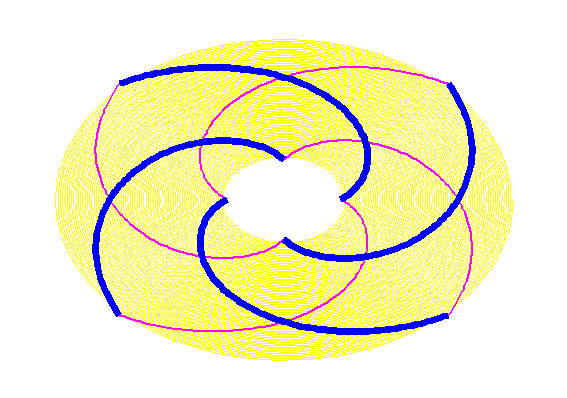
The following figure shows the plan view of a conceptual spheromak with 3 poloidal turns and 4 toroidal turns.
A real spheromak has hundreds of turns.
PLASMA SPHEROMAK IMAGE:
Here is a photograph of a semi-stable plasma spheromak in free space, as recorded by General Fusion Ltd. cira 2012
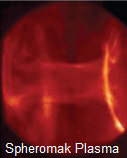
Comparable spheromak photographs are available in the paper Spheromak formation and sustainment studies at the sustained spheromak physics experiment using high-speed imaging and magnetic diagnostics by Romero-Talamas et al, Physics of Plasmas, vol 13, 2006.
SPHEROMAK GEOMETRY:
Note the circular symmetry about the major axis (R = 0) through the spheromak core.
Note the mirror symmetry about the spheromak's equatorial plane (Z = 0).
Note that the position of the spheromak wall can be described by a function Zw(Rw) in cylindrical coordianates where:
Zw(Rw) = -Zw(Rw)
Note that the spheromak wall intersects the equatorial plane Z = 0 at R = Rc and at R = Rs, where:
Rs > Rc.
Let Ro be the value of R at which the spheromak length is maximum.
Note that the spheromak length parallel to the Z axis at R = Ro is 2 Ho.
Define:
Kr = (Rs / Rc)
where:
Rs = outside spheromak wall radius at Z = 0;
Rc = inside spheromak wall radius at Z = 0;
and
Kr = (Rs / Rc)
For an experimental plasma spheromak:
Kr ~ 4.2
RESULTS OF SPHEROMAK THEORY:
A spheromak is a stationary solution to Maxwells equations of electro-magnetism that permits a quantum charge Q to localize a stable amount of electric and magnetic field energy Ett.
The total field energy Ett contained in a spheromak is inversely proportional to the linear size of its spheromak wall.
The linear size of a spheromak is indicated by nominal radius Ro.
Spheromak retain their relative geometry over a large range of energy.
The volume integral over all space of the spheromak's electric and magnetic field energy densities divided by C^2 is the spheromak's rest mass.
There are two possible orientations of a spheromak's toroidal magnetic field with respect to the spheromak's poloidal magnetic field.
Spheromaks are fundamental to the existence of atomic particles and toroidal shaped semi-stable plasmas.
The static charge behaviour of a spheromak accounts for quark charge properties.
A stable quantum charged particle such as an electron or a proton is a spheromak.
Spheromaks account for the absorption and emission of photons by particles, atoms and plasmas.
Spheromaks account for electrostatic chemical binding.
Application of a strong external magnetic field to a spheromak causes the spheromak's total energy to be dependent on the orientation of the spheromak's Z axis with respect to the externally applied magnetic field. Hence, under the influence of an external magnetic field, a spheromak has both aligned and non-aligned energy states. A spheromak's transition between an aligned state to a non-aligned state causes the absorption or emission of a photon. This process is known as nuclear magnetic resonance and is the basis of medical magnetic resonance imaging that senses water content in human tissue.
SUMMARY:
A spheromak is formed by a closed filament of charge Q with length Lh that continuously circulates around a closed path at the speed of light C. This filament path defines a quasi-toroidal shaped closed surface known as the spheromak wall. This wall divides the local space into two regions. Inside this wall the energy vector field is toroidal magnetic. Outside this wall the energy vector fields are mixed poloidal magnetic and radial electric. The vector fields contain the energy that for a quantum charged particle is the particle's rest mass. The spheromak core contains a static chare of sign opposite to Q and about (1 / 3) the magnitude of Q
The closed filament path of a real spheromak contains hundreds of poloidal and toroidal turns which collectively contribute to the local magnetic and electric field energy concentrations.
Note that the net charge on a spheromak =(filament charge) - (static charge). If the filament charge is
Q and if the static charge is (- Q / 4), then the net charge is:
Qn = (3 Q / 4)
or
Q = (4 / 3) Qn
and the static charge is:
- Qn / 3,
in conformity with quark theory.
Due to the mutual orthogonality of the toroidal and poloidal turns, the closed filament length Lh is given by:
Lh^2 = (Np Lp)^2 + (Nt Lt)^2
An isolated stable charge in a vacuum will tend to adopt a perfect spheromak geometry. A charged particle with an imperfect spheromak geomatry will tend to absorb or emit photons to become more stable.
PLANCK CONSTANT:
In a vacuum the relative geometry of the spheromak's filament path is constant and the path length Lh is proportional to the spheromak's linear size. The energy content E of a spheromak is inversely proportional to the spheromak's nominal linear size Ro. The frequency F of a spheromak is:
F = C / Lh.
Hence, since both field energy Ett and spheromak frequency F are proportional to (1 / Ro) the rato (E / F) = h is a constant known as the Planck Constant. When a spheromak of energy Ett absorbs or emits an electromagnetic photon of energy dEtt the operative equation is:
dEtt / dF = h
where dEtt is the energy carried by the photon and dF is the photon frequency.
For an isolated charged particle the spheromak geometry is stable, so that h is a stable constant. Photons are emitted as a result of changes in charged particle assembly energy. This physics is responsible for the quantization of energy carried by electromagnetic photons.
If an external magnetic field is applied to a spheromak the spheromak's contained energy will vary depending on the strength of the external magnetic field and the degree of alignment of the spheromak's poloidal magnetic field with the external magnetic field. Radio frequency photons are absorbed or emitted as the spheromaks transition between non-aligned and aligned states.
In condenses matter the spheromak's closed filament charge path is slightly affected by fields associated with other nearby charged particles. Hence the apparent value of h slightly varies, depending on the spheromak's local environment.
In a plasma charged particles move along paths similar to spheromak paths, which enables the existence of semi-stable plasma spheromaks.
MATHEMATICAL MODEL OF A SPHEROMAK:
On this web site spheromak field energy density functions are developed in terms of spheromak size, geometry, number of poloidal filament turns Np, number of toroidal filament turns Nt, charge and current parameters. The spheromak field energy density functions yield spheromaks with known static electric and magnetic field energy content. Hence the total spheromak static electric and magnetic field energy is expressed in terms of measureable parameters. It is shown that quantum mechanical properties, such as the Planck constant and Fine Structure constant, in combination with quantization of charge, arise from these parameters.
APPROACH:
The focus of the spheromak mathematical model developed on this web site is on practical engineering issues rather than quantum mechanical theory. The result is a simple mathematical model that gives closed form solutions to problems that would otherwise likely require extensive computing power.
The utility of the spheromak mathematical model is demonstrated by comparison of predictions from the spheromak mathematical model to experimental data. Spheromaks account for many experimentally observed quantum mechanical phenomena.
In most introductory physics courses electricity and magnetism are taught from a point charge and force perspective. However, dealing with spheromaks from a point charge and force perspective is mathematically difficult. It is mathematically much simpler to recognize that a force is the result of a change in field energy density with respect to position and deal with spheromaks from a field energy density perspective.
It is likely helpful for the reader to grasp the electromagnetic principles set out on the web page titled CHARGE FILAMENT PROPERTIES before moving on to study the structure and energy content of a spheromak.
This web page last updated May 28, 2026.
| Home | Energy Physics | Nuclear Power | Electricity | Climate Change | Lighting Control | Contacts | Links |
|---|